Information Science and Related Technologies in Education
3D Visualisation and Virtual Reality

Applications of 3D & Virtual Reality in Science Education

In recent years, VR has been rated as one of the most important technologies which are expected to re-shape our socio-cultural life in the near future because it has a wide diversity of impressive and practical applications such as 3D medical imaging, product and architectural design, visualization of complex scientific data, molecular/crystal modeling, games/entertainment, training and education. With the rapid advancement in 3D and computer technologies, VR has become much more user-friendly and affordable in prices and so it will likely be incorporated as a part of the IT environment in local schools within a few years. Why do we advocate the use of VR technologies in university science degree programs? Based on our professional experience in teaching various subject areas, we have uncovered and identified many topics containing at least one of the following special characteristics/ features which are well-known to cause obstacles/difficulties to learning in many students.:

  • Misconception (or called alternative conception), misinterpretation or misunderstanding are easily resulted when the 3D objects (e.g. magnetic/electric field pattern, multi-dimensional mathematical functions, 3D geometry, product design or sculpture) are made in flat 2D projection (or monoscopic images which lack the depth clues) or in 3D material models (e.g. bonding misconception inherent with the sticks used in molecule or crystal models).
  • Certain experiments, practices or demonstrations are less favorable for carrying out in real-life because they are either embedded with potential hazards or bioethical implications (e.g. dissection of human body or other living organisms) or too expensive in acquiring the necessary equipment.
  • The processes or phenomena are almost impossible to observe or control in the real world situation because of the spatial (e.g. viewing and navigation around the Solar system) or temporal constraints (e.g. particle/atomic motion/interaction in the microscopic scale).
  • VR can more effectively stimulate the students' interest of learning science and provide the sort of interactivity to facilitate the students' deep level of learning as they can freely explore or observe in detail on what are in doubt.
Scientific visualisation of complex experimental or computer-generated data, models or specimens always involves the use of various kinds of 3D and virtual reality (VR) display technologies.  There are six types of them which can be easily shown on a multimedia computer and transmitted through the Internet and they are listed as follows:
3D Visualisation Through Shutter Glasses
Panoramic Scenes

A free creation tool called HotMedia is available from IBM.

3D Photo Objects
VRML Objects

A 3D modeller shareware for Windows 95/98/NT called AC3D is available from Andy Colebourne.


Anaglyph Images Through Red-Blue Glasses
Random Dot Stereograms

The key advantages of using 3D/VR technologies are that they could not only allow the learners look at the objects from different perspectives but also help to eliminate the learners' misconception or illusion arising from the projection of the real 3D objects onto flat 2D photos or drawing.


Some technologies can provide a sort of almost first-person experience to the learner by allowing the learner to manipulate the objects freely in the three-dimensional space.

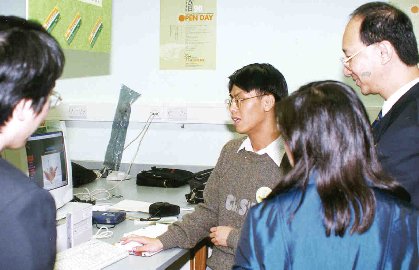
Left photo: Demo by a Science student to Dr. Pang on the use of 3D Photo Objects to study the structure of flowers.


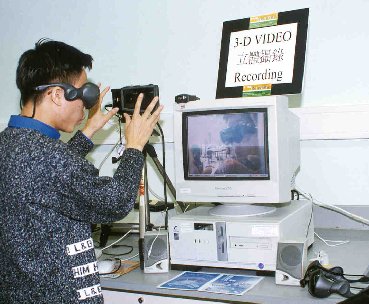
Some 3D and virtual reality technologies require the wearing of certain spectacles (e.g. LCD shutter glasses) for acquiring the real depth perception of the objects.  Right photo: Real-time recording of 3D video on a computer.


Some viewing methods may induce some sort of unpleasant feeling to the viewers after prolonged viewing. 

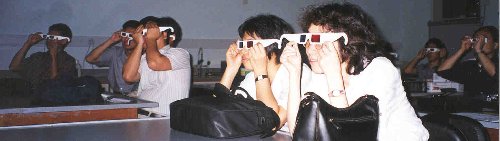
Left photo: Using red-blue filter glasses to view analgyph images.

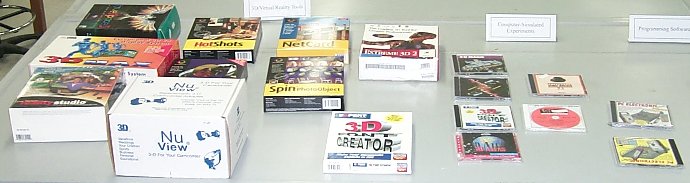
Some typical software for creating the 3D/VR computer objects are shown below:

We have developed plenty samples of 3D/VR objects based on the aforementioned six types of technologies for educating the HKIEd students.  Click the button below to browse some samples on the Internet.


|[Chinese version]|[Virtual Reality and 3D Visualisation]|[Home Page]
Editors: Dr.YEUNG Yau Yuen, Mr LEE Yeung Chung and Mr. WANG Xiaojun
Copyright (C) 1999-2001 HKIEd  HAS Centre. All Rights Reserved.